Unlocking 40x increase in cell safety without sacrificing energy density for aerospace application
Partnering with an aerospace client and their cell manufacturer, Electric Goddess deployed unique knowledge and custom testing capabilities for an advanced cell chemistry.
May 18, 2026
When your mission depends on battery systems that must perform with high reliability, Electric Goddess is the partner you call. We’re experienced and driven by purpose. We advance battery technology.
Our team’s expertise is rooted in real-world experience: we've designed, built, and tested battery systems for satellites, aerospace applications, and high-performance ruggedized systems. We engineer solutions hands-on, enhancing battery performance from individual cell chemistry to full battery packs.
The ask
The Challenge:
A company had an off-the-shelf calorimeter explode while testing advanced cells for their battery electric aircraft. They called Electric Goddess to determine the root cause of the testing failure, which resulted in a plan to build a custom calorimeter to achieve their goals.
Testing a coin cell or a 5Ah cell in a calorimeter is much less exciting energy wise than a 30Ah Silicon anode production cell. Defining the test, building a new style of equipment, and successfully capturing results was the challenge.
There was no market availability of equipment capable of doing the job.
Why it Matters:
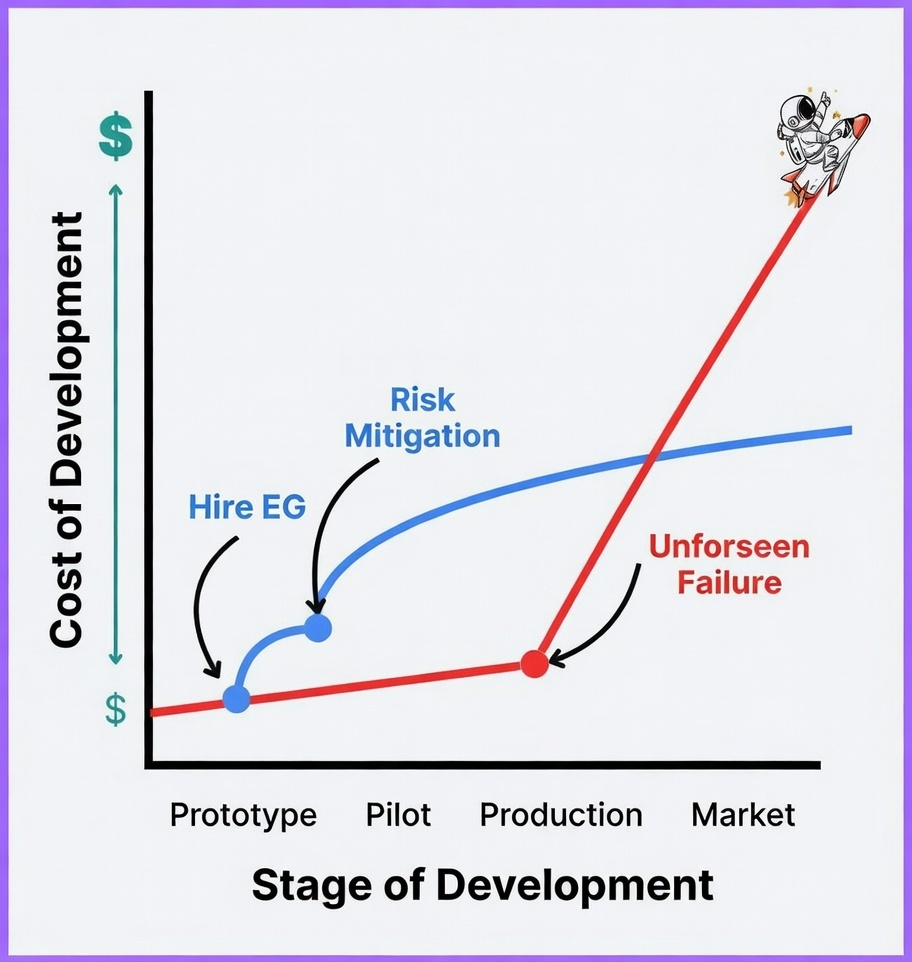
A $250K calorimeter destroyed can delay a technical development program. Suddenly, limited progress on cell, module, pack development. When R&D stalls, engineering talent sits idle while burn rates remain unchanged, schedules slip, and vital safety questions linger. Lost dollars, lost time, lost momentum.
For innovation teams, battery designers, and high-consequence R&D leads, this case highlights the value of custom, precise, and adaptive safety testing. Electric Goddess’s ability to build innovative, custom tools and run complex test scenarios in-house put the client back on track at a fraction of the time and cost quoted by large facilities.
The built-for-batteries calorimeter Electric Goddess engineered, calibrated, and validated allows for early testing in development to mitigate risk in battery design concepts.
EG Pro Tip: Early testing can save $$
Our approach
Overview
Given the cell’s extremely reactive nature and lack of viable third-party testing options, we designed and custom-built the ARC (accelerated rate calorimeter) system to safely and precisely measure energy release and pressure during induced thermal runaway.
In energetic battery failure events, direct heat flux is difficult to measure, gas evolution and internal reactions are highly transient, and internal cell temperatures are not representative of system-level energy. ARC favors energy equivalence over event dynamics.
The ARC unit was built using stainless steel, specialized baffles, and innovative gas-flow designs, enabling precise measurements of energy, pressure, and temperature during highly energetic battery failures. It is currently the most capable known ARC for Li-ion cells and modules.
Our approach in this case study included the nail penetration initiation method. Our custom setup provides capabilities tailored to the latest battery science compared to off-the-shelf equipment at most testing labs. We later updated our ARC equipment to include the ability to take gas samples during the test for mass spectroscopy and additional initiation methods.
WATCH: Chief Scientist walks through initiation methods with our custom calorimeter
Detailed methodology & process:
Background and calibration
ARC plate temperature response can be used as a calorimetric proxy for energy: if you inject known energies into the system the plates warm up in a repeatable way.
The Electric Goddess team built a 25-step calibration dataset using a highly accurate energy injection technology across multiple runs. For each of these, a test article was surrounded by thermally coupled metal plates instrumented with multiple temperature sensors. Because the plates dominate the early heat absorption, their temperature response becomes a reliable proxy for total energy release.
The ARC plates regulate heat distribution, provide repeatable thermal mass, and serve as the main calorimetry interface. Their high thermal conductivity and mass absorb initial heat, allowing embedded thermocouples to measure the resulting temperature increase, which reliably indicates the total energy released by the test article. Heat released during the event was absorbed by the plates, producing a measurable temperature rise.
Total energy release (Joules) was estimated by time-integrating the plate temperature response and applying an empirical calibration derived from known-energy runs performed in the same physical configuration.
Experiment
After calibration, multiple development cells were tested utilizing the ARC process to benchmark data across various client cell types. Testing also included an Argon environment in the ARC to understand reactions of the cell materials without atmosphere.
Each cell had various novel characteristics, such as small changes to additives in electrolytes. By running the test process below, Electric Goddess qualitatively and quantitatively compared each sample, providing useful feedback to both the cell manufacturer and integrator of the cell into a battery module.
Evaluation Preparation:
Charge cells to 100% SOC
Weigh before (and after the test) to determine EUCAR rating (0-7 scale).
Location Preparation:
Move calorimeter test assembly to approved location for setup
Tests were run outdoors in a stainless-walled enclosure with active gas scrubbing to protect personnel and the environment.
Chamber Purge:
With the chamber open, a blower was used to ensure all temperature sensors in the heat exchanger pipe registered at below 30°C
Loading:
Place the appropriate test sample cell into the test fixture
Seal the Chamber:
Seal and bolt ARC sample chamber door; clear the area of any safety risks
Data Recording:
Ensure the sensors are connected and reporting to the recording device
Begin data logging equipment recording
Activation of TR Mechanism:
Activate the gas solenoid to power pneumatic ram [This drives the nail through the cell, triggering the nail penetration ARC test]
Wait Period:
Reach thermal equilibrium <30°C of the calorimeter.
Data Processing
Upload data logs for processing: Joules, Temperature, Pressure, Voltage [Gas sampling was not used in this particular project]
Further Data Collection:
Apply the same background + metric workflow to a new event run (unknown energy out)
Quantitative Analysis:
Estimate Joules released for the event by applying the chosen calibration equation to convert the metric into estimated Joules released (point estimate)
Use the calibration method to determine Joules of energy release
Re-weigh cells for the EUCAR rating [Temperature and pressure provided via data logs]
Qualitative Analysis:
Begin cleaning process of internal cell debris fragments from previous test.
Inspect for and replace any potential damage to the test fixture discovered.
Inspection of test sample to provide qualitative notes on failure and recommendations.
This is a clamping plate after a EUCAR 7 ARC test of a 30Ah Silicon anode cell.
Electric Goddess’ rapid post-test cause → effect chain
ARC data revealed an ultrafast, total energy release (~0.2 s) with plasma temperatures generated. Even Tungsten-Rhenium temperature sensors in the proximity of the cells were melted and destroyed in under 1 second. The cell demonstrated uncommonly rapid TR energy release rates and peak temperatures.
The cell manufacturer produced updated trial cells for ARC and sent several batches to EG. The ARC tests were conducted and EG delivered Joules of energy release and power rate data within 24 hours of receiving each batch.
Bracket testing with different electrolyte blends showed drastic changes in thermal runaway energy release, as well as the duration of energy release. By tracking which changes made improvements in safety and which made things worse, it was possible to understand the mechanisms involved during this cells TR.
EG flagged the confidential electrolyte component content as the most likely driver of the rapid exothermic reaction. No proprietary cell recipes were exchanged. EG translated observations into “directional nudges”.
EG and Cell Manufacturer undertook further refinement to achieve the safety threshold without sacrificing Wh/kg. This was done in an iterative loop (six cells → data → formula changes) and repeated for a few cycles. The in-house stainless ARC ran multiple tests per day. The ultimate outcome: a single additive change in the cell chemistry quartered thermal output.
Ultimately, the team collectively achieved a 40× drop in thermal power, a 70-80% cut in total Joules, and gas pulse pressure low enough for module propagation barriers to survive.
Cell now “tame enough” to package toward DO-311 compliance, clearing a blocker to flight-worthy modules.
Confidence restored: tests demonstrated a viable path to a ~400 Wh/kg cell with an acceptable functional safety design foundation for the aircraft.
Savings: project finished in <20% of the time and <30% of the spend quoted by other tier-1 labs. Other labs also did not quote this work due to its complexity.
Program momentum regained: the customer resumed full-scale pack design and hit the next prototype flight window.
Electric Goddess
Client Benefit
Battery Safety
~40× power factor reduction
Product Development Experience
100% retention of gravimetric energy density
Cross-Disciplinary Expertise
~80% faster + ~70% more cost effective than other tier 1 labs.
Custom Testing Capabilities
Path to use cutting-edge cell chemistry. Niche tools and methods leveraged that are beyond the reach of large commercial labs.
Summary
Testing late in the development cycle cost this aerospace program a calorimeter, weeks of downtime, and battery design unease. Electric Goddess stepped in, built and calibrated the equipment from the ground up, provided a test plan, and provided unique support to cut thermal-runaway power by more than 40x without sacrificing the ~400 Wh/kg target cell energy density. The success of this project allowed the aerospace battery team to resume pack design and meet the next flight window.
When dealing with large cells, significant energy release, and new technologies, Electric Goddess paved the way for accurate calorimeter testing for battery systems. Smaller versions of this calorimeter are available for testing as well.
The cautionary lesson is clear: stress-test advanced cells as soon as possible. Early, adaptive safety work uncovers hidden chemistry risks while design choices are still inexpensive to change. Electric Goddess brings mission-critical battery programs data-driven answers at the speed of engineering curiosity.
If an upcoming cell selection must be proven safe before schedules and budgets tighten, start the conversation now. Translate data into safer batteries.


.jpg)